Flying & singing zebra finches - Birdpark#
Data from Rüttimann et al. [2025] (paper, zenodo), a multimodal dataset of zebra finch groups with synchronized video, microphone arrays, and backpack-mounted vibration transducer (accelerometers).
The code below shows how one can convert that existing dataset into the Trials.nc format. The sampling rate of the vibration transducer is very high (24kHz), therefore if the bottom plot loads very slowly, you may consider using the Downsample option next to Load.
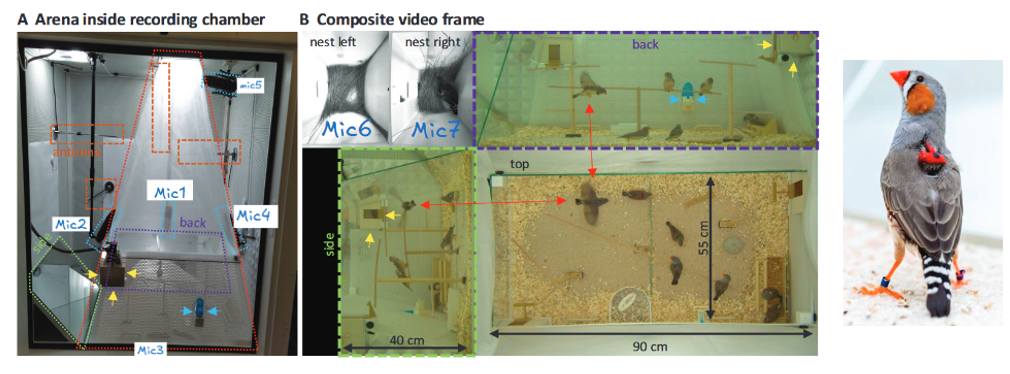
Left: GUI screenshot, Right: Adapted from Rüttimann et al. [2025], Fig. 2C
import zipfile
from pathlib import Path

import h5py
import numpy as np
import pandas as pd
import requests
import xarray as xr
from audioio import write_audio

from ethograph.io.pairing import pair_media
Download dataset#
You can download the entire dataset from here or use the code below. I only tested the copExpBP08 recording. If problems arise, the ReadMe here is very helpful.
try:
    _here = Path(__vsc_ipynb_file__).parent
except NameError:
    _here = Path().resolve()

data_folder = _here.parent / "data" / "birdpark"
data_folder.mkdir(parents=True, exist_ok=True)

response = requests.get("https://zenodo.org/api/records/13144875")
data = response.json()

for file in data["files"]:
    if file["checksum"] == "md5:32d1ae6049556c803f68b6d354c952ca":
        print(f"Checksum matches: {file['key']}")
        output_path = data_folder / file["key"]
        r = requests.get(file["links"]["self"], stream=True)
        with open(output_path, "wb") as f:
            for chunk in r.iter_content(chunk_size=8192):
                f.write(chunk)
        if output_path.suffix == ".zip":
            with zipfile.ZipFile(output_path, "r") as zip_ref:
                zip_ref.extractall(data_folder)
        break
Build NWB alignment and dataset#
# Recording: copExpBP08, session BP_2021-05-25_08-12-51_655154_0380000
fps = 47.6837158203125
audio_sr = 24414.0625  # audio and accelerometer sampling rate (from dataset metadata)

recording_folder = data_folder / "copExpBP08"
h5_path = recording_folder / "BP_2021-05-25_08-12-51_655154_0380000.h5"
video_path = recording_folder / "BP_2021-05-25_08-12-51_655154_0380000.mp4"
audio_path = video_path.with_suffix(".wav")
nc_path = video_path.with_suffix(".nc")

# Read H5 file
with h5py.File(h5_path, "r") as f1:
    radioSignals = f1["/radioSignals"][()]  # accelerometer (one row per channel)
    daqSignals = f1["/daqSignals"][()]  # microphone channels

# Create .wav file from microphone channels
write_audio(audio_path, daqSignals.T, audio_sr)

# ─── Build session table ───
# trial=1 matches the ID assigned when loading a plain Dataset as a single-trial TrialTree
# NWB alignment stores bare filenames (resolved against video_folder /
# audio_folder at GUI-load time) — never the absolute paths on this machine.
session_table = pd.DataFrame(
    {
        "trial": [1],
        "video_0": [video_path.name],
        "audio_0": [audio_path.name],
    }
)

nwb_path = recording_folder / ".ethograph" / "alignment.nwb"
pair_media(
    trial_table=session_table,
    stream_rates={"video": float(fps), "audio": float(audio_sr)},
    output_path=nwb_path,
    media_root=recording_folder,
)

# ─── Build xarray dataset ───
time_coords = np.arange(radioSignals.shape[1]) / audio_sr

ds = xr.Dataset(
    data_vars={
        "vibration": xr.DataArray(
            radioSignals.T,
            dims=["time", "individuals"],
        ),
    },
    coords={
        "time": time_coords,
        "individuals": ["male (red radio)", "female (yellow radio)"],  # specific to copExpBP08
    },
    attrs={
        "fps": fps,
        "audio_sr": audio_sr,
    },
)

ds.to_netcdf(nc_path)
print(f"Saved to {nc_path}")
ds # Inspect
Decent for segmentation#
voc.segment.meansquared(
    <data>,  # set by GUI
    <sr>,    # set by GUI
    threshold=15000,
    min_dur=0.003,
    min_silent_dur=0.0001,
    freq_cutoffs=(500, 10000),
    smooth_win=0.32,
    scale=True,
    scale_val=32768,
)