Kinematic changepoints#
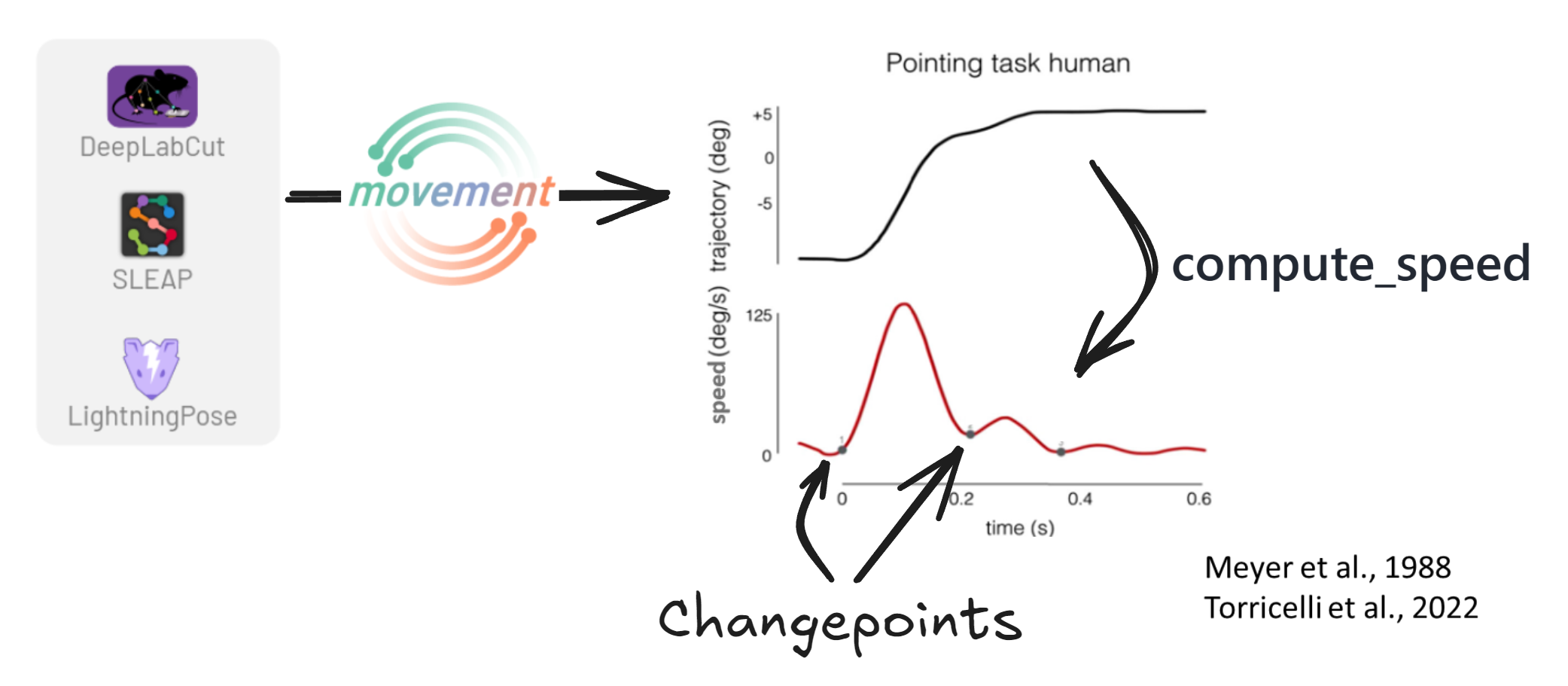
One example of changepoints occurring at behavioural boundaries are speed minima. In point-to-point reaching tasks, the hand speed profile is characterised by a unimodal bell-shaped curve with two speed minima (Torricelli et al., 2023), where the minima correspond to the onset and offset of the movement, and the peak of the speed bump marks the point where the hand starts decelerating. These minima can even be used to identify sub-movements, such as the small second corrective speed bump in the figure below (Meyer et al., 1988).
Troughs (local minima)#
Finds local minima in the signal using scipy.signal.find_peaks applied to
the negated signal. Troughs in speed often correspond to moments where an
animal pauses or reverses direction.
Parameters are passed directly to scipy.signal.find_peaks(): height,
distance, prominence, width, etc.
Turning points#
A custom algorithm that identifies the boundaries of peak regions rather than the peaks themselves. The idea is that behaviour transitions happen not at the peak of a movement, but where the animal starts or stops accelerating.
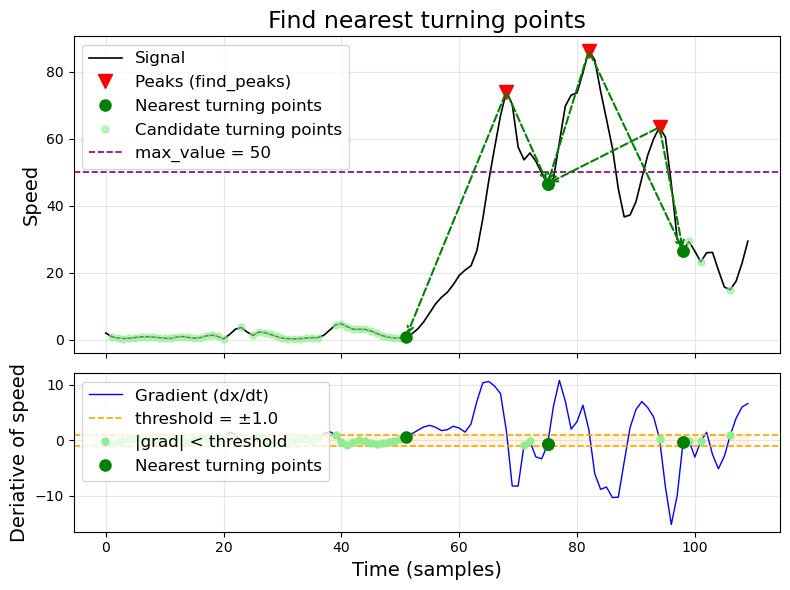
The algorithm works in four steps:
Compute the gradient of the signal and find all indices where
|gradient| < threshold— these are candidate turning points (near-stationary regions).Find peaks in the original signal using
scipy.signal.find_peakswithprominenceandwidthparameters.For each peak, select the closest candidate turning point to its left and right. These define the boundaries of the peak region.
Filter by
max_value: any candidate turning point where the signal exceedsmax_valueis discarded. This prevents selecting turning points on high speed plateaus.
Parameters:
Parameter |
Description |
|---|---|
|
Maximum absolute gradient to qualify as a turning point. Lower = only very flat regions. |
|
Discard turning points where signal exceeds this value. |
|
Minimum peak prominence (passed to |
|
Minimum distance between peaks (passed to |
All kinematic changepoints also include NaN-boundary markers — transitions between valid data and NaN gaps are automatically added as changepoints.
Usage#
Select a feature in the Data Controls (e.g.
speed).Open the Kinematic CPs panel.
Choose a method (
troughsorturning_points).Click Configure… to adjust parameters.
Click Detect.
The changepoints are stored in the dataset as {feature}_{method} (e.g.
speed_troughs) and persist when you save.
Data format#
Changepoint arrays are binary (0 or 1) integer arrays that share the
same time dimension as their target feature. They require:
attrs["type"] = "changepoints"attrs["target_feature"]— name of the feature variable they annotate
ds["speed_troughs"] = xr.DataArray(
    cp_binary,                           # shape: (time, keypoint, individual), values 0 or 1
    dims=["time", "keypoint", "individual"],
    attrs={
        "type": "changepoints",
        "target_feature": "speed",
    },
)
To compute changepoints programmatically, use
add_changepoints_to_ds():
import ethograph as eto
from ethograph.features.changepoints import find_troughs_binary

ds = eto.add_changepoints_to_ds(
    ds,
    target_feature="speed",
    changepoint_name="troughs",
    changepoint_func=find_troughs_binary,
)
add_changepoints_to_ds() uses
xarray.apply_ufunc() with vectorize=True, so your detection function
only needs to handle a 1-D signal.
For pynapple data, changepoints are stored as a
TsGroup — one timestamp series per unit (keypoint,
channel, neuron, …) with metadata columns marking it as a changepoint set.
Use add_changepoints_to_nap():
import pynapple as nap
from ethograph.io.pynapple import add_changepoints_to_nap
from ethograph.features.changepoints import find_troughs

speed = nap.TsdFrame(
    t=time_s,
    d=speed_array,                       # shape: (n_time, n_keypoints)
    columns=["nose", "left_ear", "right_ear", "tail"],
)

cps = add_changepoints_to_nap(
    speed,
    target_feature="speed",
    changepoint_func=find_troughs,
    prominence=0.1,
)
# cps is a TsGroup — one Ts per column with:
#   metadata.source_label = column name (e.g. "nose")
#   metadata.target_feature = "speed"
#   metadata.type = "changepoints"
Accepts Tsd, TsdFrame, or
TsGroup as input. Existing metadata columns are carried
through when the input is a TsGroup.
References#
Meyer, D. E., Abrams, R. A., Kornblum, S., Wright, C. E., & Keith Smith, J. E. (1988). Optimality in human motor performance: Ideal control of rapid aimed movements. Psychological Review, 95(3), 340-370. https://doi.org/10.1037/0033-295X.95.3.340
Torricelli, F., Tomassini, A., Pezzulo, G., Pozzo, T., Fadiga, L., & D’Ausilio, A. (2023). Motor invariants in action execution and perception. Physics of Life Reviews, 44, 13-47. https://doi.org/10.1016/j.plrev.2022.11.003