Overview#
Changepoint detection methods (Xu et al., 2025) allow finding transitions in time series data. This can be leveraged to identify candidates of action boundaries in various data formats (kinematic, audio, spectral).
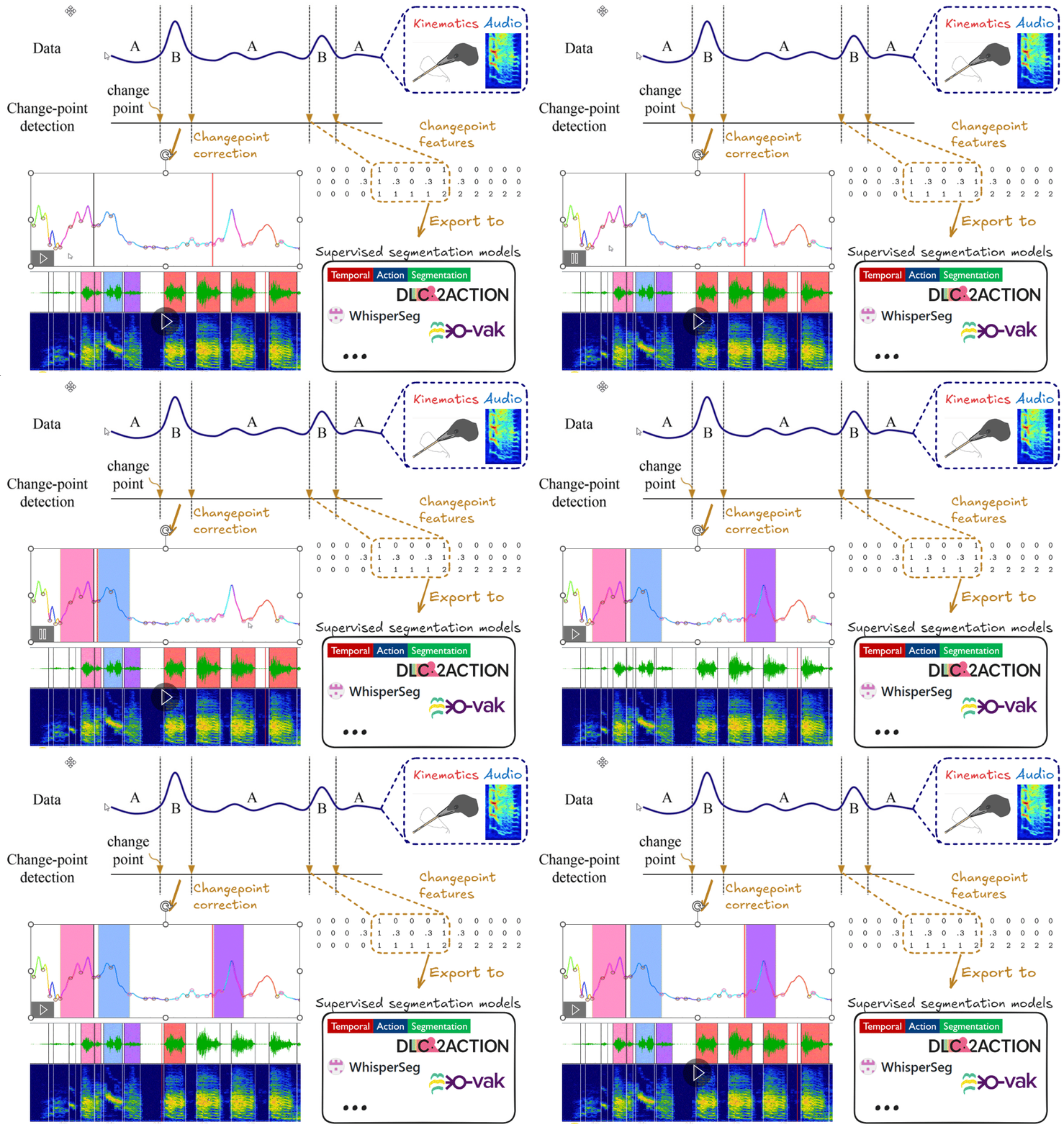
Ethograph uses changepoints in two ways:
The GUI can compute changepoints and mark them visually in a time series plot (e.g. as circles or vertical lines). When a user labels the onset/offset of a behaviour by clicking on the time series, their click is refined by jumping to the nearest changepoint. For example, when labelling the onset of a movement, the user may click close to a speed minima, and the GUI will refine the selection to jump exactly to that minima. This increases the accuracy and consistency of human labelling.
Changepoint detection methods often have a false-positive problem (Cohen, 2022), where a large subset of the detections are not at real behavioural boundaries but false positives. Similarly, the changepoint algorithms often overspecify by providing too many changepoints. The human-in-the-loop through labelling can then specify which of these detections are good candidates. Next, these changepoint times are converted into learnable changepoint features, and exported along with human behavioural labels to supervised segmentation models (e.g. transformers). By receiving all changepoints along with human labels, these models can learn when certain changepoint features co-occur with behavioural boundaries, thus also refine their segmentation accuracy on unseen data.
Next#
Kinematic changepoints — troughs, turning points
Audio changepoints — VocalPy and VocalSeg methods for acoustic signals
Ruptures — general-purpose changepoint detection
Changepoint correction — label-boundary correction pipeline
References#
Cohen, Y., Nicholson, D. A., Sanchioni, A., Mallaber, E. K., Skidanova, V., & Gardner, T. J. (2022). Automated annotation of birdsong with a neural network that segments spectrograms. eLife, 11, e63853. https://doi.org/10.7554/eLife.63853
Gu, N., Lee, K., Basha, M., Kumar Ram, S., You, G., & Hahnloser, R. H. R. (2024). Positive Transfer of the Whisper Speech Transformer to Human and Animal Voice Activity Detection. ICASSP 2024. https://doi.org/10.1109/ICASSP48485.2024.10447620
Kozlova, E., Bonnetto, A., & Mathis, A. (2025). DLC2Action: A Deep Learning-based Toolbox for Automated Behavior Segmentation. bioRxiv. https://doi.org/10.1101/2025.09.27.678941
Xu, R., Song, Z., Wu, J., Wang, C., & Zhou, S. (2025). Change-point detection with deep learning: A review. Frontiers of Engineering Management, 12(1), 154-176. https://doi.org/10.1007/s42524-025-4109-z