3. Detect — optional, if your animals wear tags#
A click and a tag detector produce the same kind of thing: a position read off the pixels of one specific frame. EthoGraph calls both observations, and the fill interpolates between them — so any detector composes with any fill backend. Five clicked frames becoming several hundred detected ones is what stops optical flow drifting and gives PosePAL far more to fit to.
Through trial and error I settled on AprilTag tag36h11, which works very
well on moving 5mm and 10mm wide tags.[1] Two smaller families are
offered alongside it, and EthoGraph prints exactly what it can read — a
sheet of tags the detector cannot decode would be a trap.
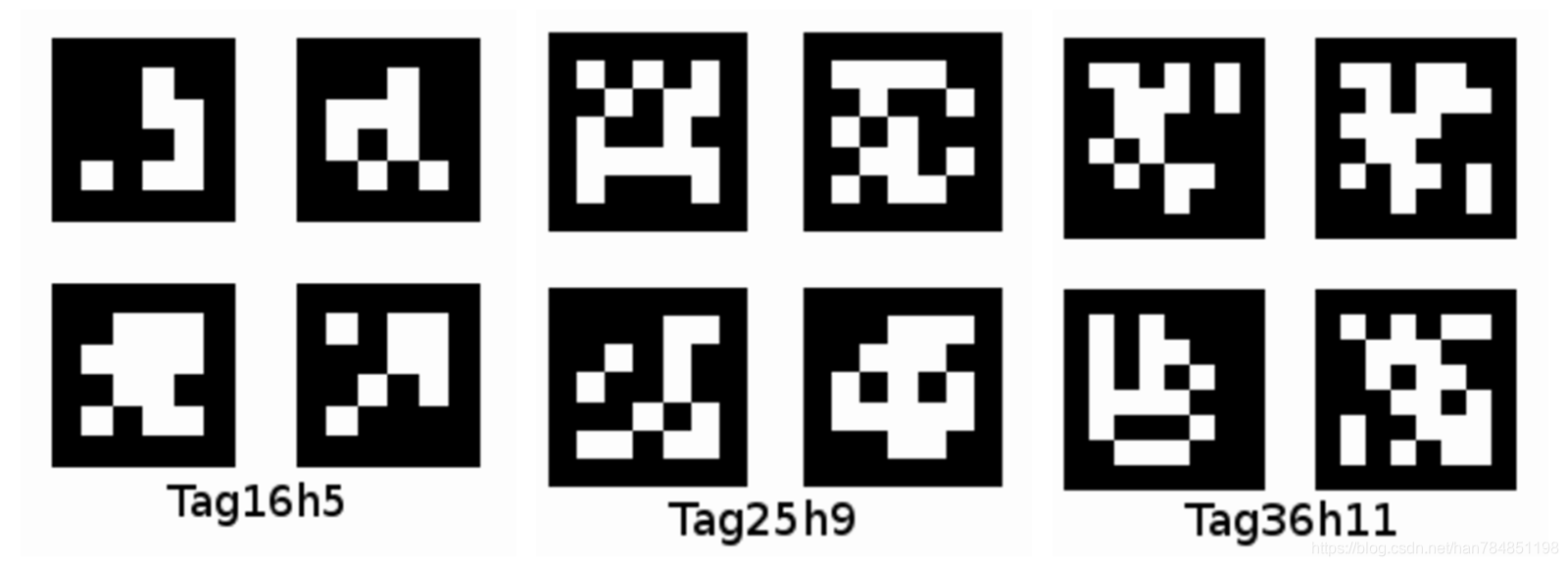
Three AprilTag families. The first number is how many data bits a tag carries
(a 4×4, 5×5 or 6×6 grid of modules); the number after the h is the smallest
Hamming distance between any two valid codes — how many bits have to be misread
before one ID turns into another valid ID.#
Family |
Hamming |
Grid |
Data bits |
Unique tags |
Modules of paper |
|---|---|---|---|---|---|
|
11 |
6×6 |
36 |
587 |
8 |
|
9 |
5×5 |
25 |
35 |
7 |
|
5 |
4×4 |
16 |
30 |
6 |
If your animal is very small and your pixel resolution limited, it may be helpful to take a family with a smaller grid tag16h5.
On the other hand, if those are not limiting factor, then tag36h11 will give you an orders of magnitude lower false-positive rate and
a few more distinguishable IDs.
Tuning#
Family must match what you printed — e.g. a tag16h5 tag will never decode as
tag36h11.
Downscale (quad_decimate) is how far the frame is shrunk before tags are
looked for — the real speed-against-size trade. 2.0 runs several times faster
and needs tags twice as big, which is why EthoGraph defaults it to 1.0
while the underlying library ships 2.0.
Sharpening (decode_sharpening, default 0.25) is applied to the sampled
bit pattern before it is read. Raise it for motion-blurred or slightly
out-of-focus tags.
Detect the four corners too emits each corner as its own keypoint, on top of the tag’s centre. It is for when you want the corner positions themselves — you do not need it for head direction. Orientation comes free with every decode, because a tag is a square: see head direction.
Quality threshold, on the Run panel, is the decode margin as a fraction of a
good read. A real tag scores about 1.0 and spurious reads on noise score under
0.15, so the default of 0.3 sits in the gap between them. It is applied as
results are stored, so retuning it costs nothing within a session.
Running it#
Choose a range and press Run detector. The result joins your labels as
observations; a detection never overwrites a label, and correcting one is just
clicking it. Runs are cached next to the video as <video>.detections.npz, which
is safe to delete.