5. Fill#
Pick a backend, press Fill frames between labels, and every frame from your first observation to your last gets a position. Your labelled frames always come back exactly as you placed them — a fill never overwrites a label or a detection, and never feeds on the previous fill. Frames outside that span are left empty.
Everything happens between your labels#
The span between your outermost observations — labels, plus anything a detector found — is the boundary for the whole workflow, not just for the fill:
Filling runs in the gaps between labelled frames and nowhere else.
This is what makes partial labelling well-defined. If only part of a recording
interests you — one bout, one trial, the minute the animal is actually in frame
— label its start and its end and work inside it; the rest of the video stays
NaN rather than being padded with extrapolated positions you would then have
to detect and discard. The trade is the obvious one: you get results exactly
where you put labels, so a stretch you never bracketed produces nothing at all,
however long you spend filling.
Choosing a fill backend#
Backend |
How it works |
Needs |
Cost |
|---|---|---|---|
Spline (default) |
Monotone cubic (PCHIP) interpolation per keypoint over its own labelled frames[1] — geometry only, the pixels are never read |
nothing extra |
instant |
Optical flow |
Pyramidal Lucas–Kanade, tracked forwards and backwards across each gap[2] |
nothing extra |
~video speed, CPU |
PosePAL (CoTracker3 + refinement) |
A transformer point tracker[3] whose per-keypoint appearance features are first fitted to your labels on this video [Pan et al., 2025], then tracked forwards and backwards across each gap |
torch + cotracker, GPU |
a few minutes to fit, reused by every fill made from the same labels |
Only PosePAL needs installing; see PosePAL install.
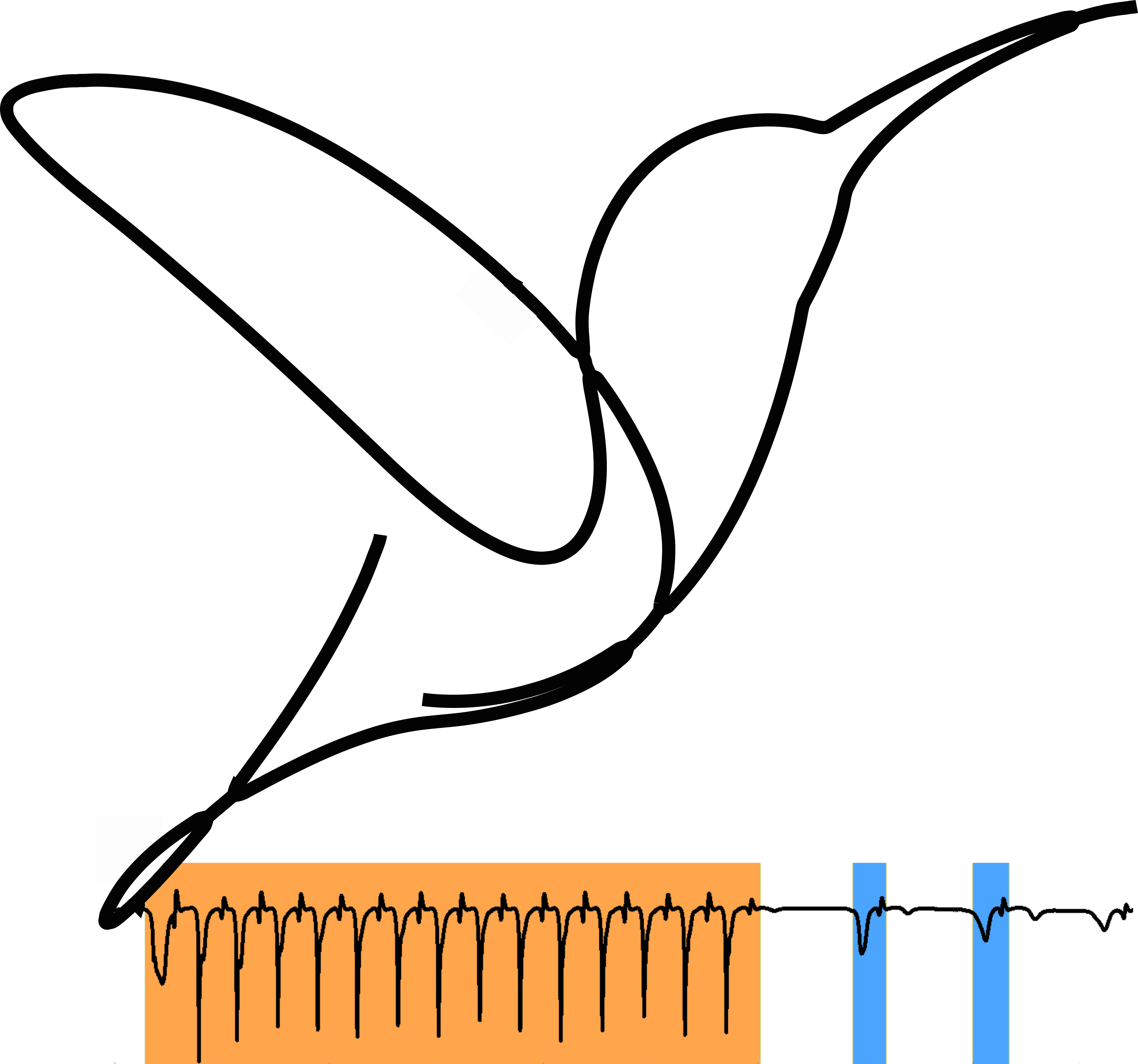
Without a GPU, start with the spline — it costs nothing and is hard to beat when motion is smooth and your labels are dense — and switch to optical flow when the path between two labels isn’t a smooth curve, like a fast turn or a wingbeat.
With a GPU, use PosePAL [Pan et al., 2025]. It handles longer gaps and larger displacements than either of the others, and because it learns what your keypoints look like in this recording, it stays on the right leg and the right animal.
Fit and track with PosePAL#
PosePAL fills in two phases, and it is worth knowing which one you are paying for:
Fit — optimise CoTracker3’s per-keypoint appearance features against the frames you labelled. Minutes on a GPU. It depends on nothing but your labels and the video.
Track — run the fitted tracker forwards and backwards across each gap. This is what produces the filled frames, and it is fast.
Fill always does both, but it skips the fit while the fit it already has was
made from exactly the labels you have now — held in memory and cached beside the
video as <video>.posepal.pt. Correct a point, approve a frame, edit the schema,
and that no longer holds: the next Fill refits by itself before tracking.
There is no fit button, because there is no decision to make; the Fill and export tab simply
says which phases the next fill will pay for, so a three-minute wait is never a
surprise. Cancelling a fill leaves your labels, your current fill and the current
fit exactly as they were.
So there is no “carry on from the old fit” anywhere: a refit is a fresh fit, started from scratch on all your labels — the reference implementation re-optimises on every press for the same reason. The only thing the cache buys you is not repeating a fit that would come out the same, which is what keeps the correction loop quick.